
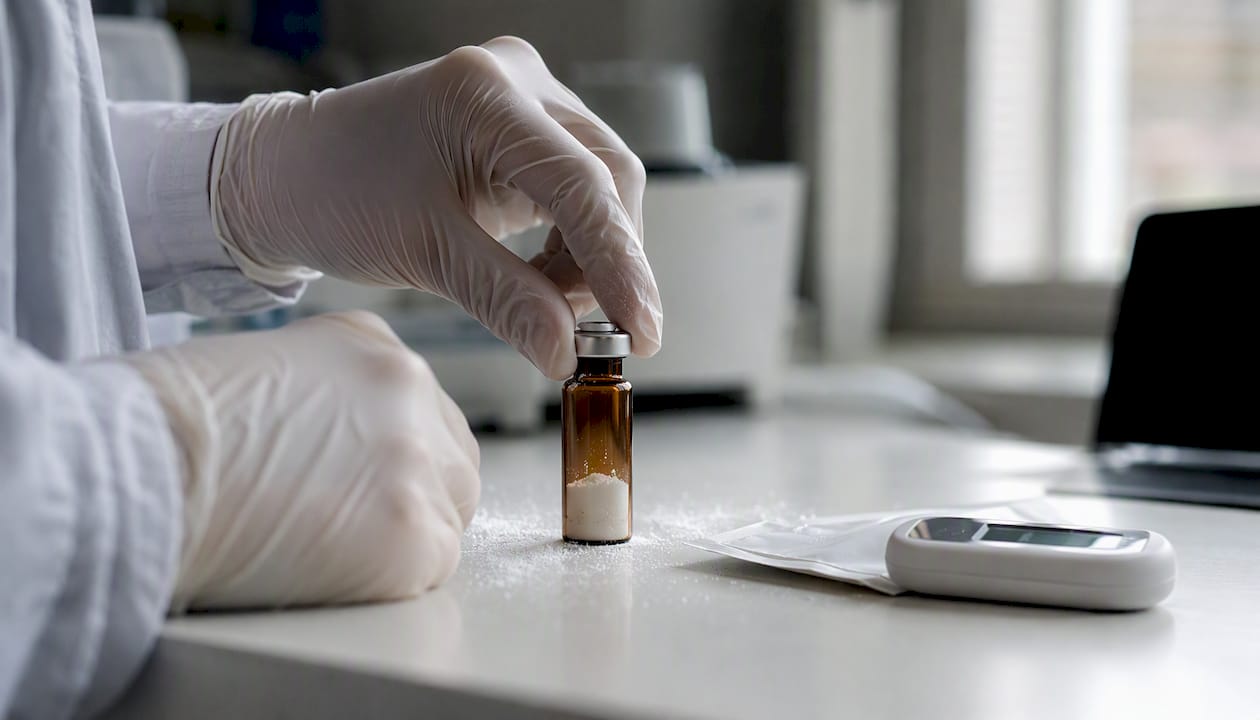
Before placing any order for research use only peptides, UK researchers must insist on three non-negotiables: a per-batch Certificate of Analysis (COA) showing molecular identity confirmed by mass spectrometry and purity of ≥98% by high-performance liquid chromatography (HPLC), evidence of independent testing from a UKAS-accredited or equivalent laboratory, and a formal institutional account verification process. The “for research use only” (RUO) label is a statement of intended use for bench science, not a regulatory exemption, and it does not authorise supply for human or veterinary administration under UK law.
Before engaging any supplier, verify the following on their website or in pre-sale documentation:
- A per-batch COA with a unique batch number, analysis date, and analyst signature
- HPLC purity data showing ≥98% purity with a chromatogram, not a summary figure alone
- Mass spectrometry confirmation of molecular ion and peptide sequence identity
- Cold-chain shipping documentation, including temperature logs and packaging specifications
- An institutional or business account verification policy that restricts supply to qualified buyers
- A clear statement that products are not for human or veterinary use
Veridian Labs, a UK-based supplier, publishes per-batch COAs with independent HPLC and mass spectrometry data and operates a cold-chain dispatch protocol, providing a practical reference point for what compliant documentation looks like. Regulatory bodies including the EMA and the US FDA have both addressed the misuse of RUO labelling, and their guidance informs the standards any credible UK supplier should meet.
This article provides general information for research professionals and does not constitute legal or regulatory advice. Researchers should verify current obligations with the MHRA or a qualified regulatory professional.
Table of Contents
- What does ‘research use only’ actually mean in the UK?
- What documents must you demand from any peptide supplier?
- How do you verify a UK peptide supplier before ordering?
- Handling, reconstitution, and cold-chain requirements for lyophilised peptides
- What are the red flags that indicate an unreliable peptide supplier?
- How Veridianlabs meets UK research-grade standards
- Key takeaways
- Why strict quality assurance is the foundation of reproducible peptide research
- Veridianlabs: institutional ordering and next steps
- Useful sources for regulatory and quality verification
What does ‘research use only’ actually mean in the UK?
RUO is a labelling designation, not a legal licence. A product labelled “for research use only” is declared by its supplier to be intended solely for in vitro or bench research, outside any clinical, diagnostic, or therapeutic context. That declaration does not remove the supplier’s or importer’s obligations under UK product law, medicines regulation, or advertising standards.
The term itself originated in US FDA regulation for in vitro diagnostic products under 21 CFR 809.10, a context that has nothing to do with systemically active injectable peptides. Applying an RUO label to a peptide that acts systemically, such as a growth hormone secretagogue or a metabolic modulator, is widely regarded by regulators as a misuse of the designation. The FDA has pursued enforcement action on precisely this basis, and the underlying principle carries weight in UK and EU regulatory thinking.
In the UK, the Medicines and Healthcare products Regulatory Agency (MHRA) governs whether a substance constitutes a medicinal product by function. A peptide that has a pharmacological, immunological, or metabolic effect in the human body may be classified as a medicinal product regardless of how its label reads. The RUO designation does not override that classification.
The Therapeutic Goods Administration (TGA) in Australia, whose guidance is frequently cited as a comparative reference in international regulatory discussions, states explicitly that research-use disclaimers alone do not change a product’s regulatory status and that importers and suppliers retain their legal obligations. The same principle applies under UK and EU frameworks.
“Unapproved peptides sold online carry substantial risks. Animal data do not reliably predict human safety, and human evidence for popular unapproved peptides is very limited.” — Stuart Phillips, McMaster University
The practical implication for institutional procurement is clear: purchasing RUO peptides for bench research is legitimate when the buyer is a qualified researcher operating within an institutional framework, the supplier has verified that status, and the material never leaves the laboratory context for which it was purchased.
What documents must you demand from any peptide supplier?
The minimum documentation package for any batch of laboratory use peptides comprises a per-batch COA with a unique batch number and issue date, HPLC purity data of ≥98% with an accompanying chromatogram, mass spectrometry data confirming molecular ion and sequence identity, and trace contamination or related-substance data. A COA that lacks a batch number or presents only a summary purity figure without the underlying analytical data is insufficient for institutional procurement.
HPLC and mass spectrometry are complementary techniques: HPLC quantifies the proportion of the target peptide relative to all detectable species in the sample, while mass spectrometry confirms that the dominant species has the correct molecular mass and fragmentation pattern. Neither method alone is sufficient. A high HPLC purity figure with no MS confirmation does not rule out a structurally similar contaminant that co-elutes at the same retention time.
The table below maps the key COA fields to what each proves and the threshold to look for.

| COA field | What it proves | Acceptable value |
|---|---|---|
| Batch number | Traceability to a specific synthesis run | Unique alphanumeric identifier |
| Peptide sequence | Correct amino acid composition | Matches product specification |
| HPLC purity | Proportion of target peptide in sample | ≥98% area under curve |
| MS molecular ion | Correct molecular mass and identity | Within ±1 Da of theoretical |
| Water content | Residual moisture affecting net content | Stated; typically ≤10% by Karl Fischer |
| Related substances | Presence of synthesis by-products or degradants | Below supplier threshold; ideally <1% each |
| Solvent residues | Residual organic solvents from synthesis | Within ICH Q3C limits |
| Analyst signature and date | Accountability and document authenticity | Named analyst, dated within batch cycle |
A detailed walkthrough of each field is available in the Veridianlabs COA interpretation guide, which is a useful reference for procurement teams preparing institutional SOPs.
Pro Tip: When a supplier’s COA is produced in-house, request evidence of independent third-party verification from a UKAS-accredited laboratory or an equivalent ISO 17025-certified facility. On an HPLC chromatogram, look for a single dominant peak at the expected retention time with no secondary peaks above 1% of total area. Multiple peaks of comparable height, or a broad asymmetric main peak, indicate impurities that warrant further investigation before the batch is used in any experiment.
For a deeper examination of when supplier COAs are insufficient and independent testing becomes necessary, the Veridianlabs analysis of COA limitations sets out the practical criteria.
How do you verify a UK peptide supplier before ordering?
Follow this ordered verification sequence before committing to any purchase. The supplier evaluation framework published by Veridianlabs provides a structured reference for each stage.
- Confirm company registration. Check the supplier’s Companies House registration number and verify it against the registered address on their website. A legitimate UK supplier will have a traceable legal entity.
- Request a sample COA before ordering. Ask for a COA from a recently dispatched batch of the specific peptide you intend to purchase. Verify that it contains all fields listed in the table above, including batch number, HPLC chromatogram, and MS data.
- Verify independent testing credentials. Ask whether analytical testing is performed in-house or by a UKAS-accredited or ISO 17025-certified external laboratory. Request the name of the testing facility and, where possible, a copy of their accreditation certificate.
- Confirm the institutional account onboarding process. A compliant supplier will require proof of institutional affiliation or professional qualification before processing an order. If a supplier sells without any account verification, treat that as a disqualifying factor.
- Review cold-chain shipping documentation. Request details of temperature-controlled packaging, whether dry ice or gel packs are used, and whether temperature logs accompany shipments. Confirm that the supplier’s dispatch and transit procedures are consistent with the storage requirements of the peptide ordered.
- Check compliance policy and RUO labelling. Confirm that all products are labelled “not for human or veterinary use” and that the supplier’s terms of sale explicitly restrict use to qualified research contexts.
Suggested questions to put to any supplier in writing:
- “Can you provide a COA for the current batch of [peptide name], including HPLC chromatogram and MS data?”
- “Is your analytical testing conducted in a UKAS-accredited or ISO 17025-certified laboratory? If so, which facility?”
- “What is your institutional account onboarding process, and what documentation do you require from buyers?”
- “What cold-chain measures are in place for dispatch, and do shipments include temperature logs?”
- “Are all products explicitly labelled ‘not for human or veterinary use’?”
Retain all supplier responses, COA copies, and accreditation evidence as procurement records. Institutional grant audits and ethics reviews may require documentation that due diligence was performed on material suppliers, and a complete correspondence file is the most straightforward way to demonstrate that.
Handling, reconstitution, and cold-chain requirements for lyophilised peptides
Most synthetic research peptides are supplied in lyophilised form, a freeze-dried powder that offers superior stability during transit and storage compared with liquid formulations. Maintaining that stability from dispatch to bench requires both appropriate supplier-side cold-chain management and correct laboratory handling on receipt.

Cold-chain storage at −20°C is the standard requirement for most lyophilised peptides, with some oxidation-sensitive or longer-chain sequences warranting storage at −80°C. The rationale is straightforward: peptide bonds and side-chain functional groups are susceptible to hydrolysis, oxidation, and aggregation at ambient temperatures, particularly in the presence of residual moisture. Temperature excursions during transit, even brief ones, can initiate degradation that is not visible on inspection but is detectable by HPLC on re-analysis.
Reconstitution and storage best practice:
- Allow the sealed vial to equilibrate to room temperature before opening, to prevent condensation on the lyophilised cake
- Use sterile, appropriate solvent (typically sterile water, acetonitrile/water mixtures, or DMSO depending on peptide solubility) at the concentration specified in the COA or product documentation
- Prepare aliquots immediately after reconstitution to avoid repeated freeze-thaw cycles; each cycle introduces mechanical stress and oxidative risk
- Label aliquots with batch number, reconstitution date, concentration, and solvent composition
- Store reconstituted aliquots at −20°C for short-term use; return unused lyophilised material to −20°C or −80°C as appropriate
- Do not store reconstituted peptide solutions for extended periods without re-verification of purity
From suppliers, require the following before accepting a shipment:
- Temperature log for the full transit period, from dispatch to delivery
- Photographic evidence of packaging condition on dispatch (dry ice quantity, insulated container type)
- A post-shipment temperature check protocol or guidance note
Pro Tip: Aliquotting immediately after reconstitution is the single most effective way to preserve peptide integrity across a research programme. For long-stored lyophilised material, particularly batches held for more than 12 months, run a spot HPLC check before use in any experiment where quantitative accuracy is critical. Degradation products that accumulate slowly may not be apparent from visual inspection of the powder.
The underlying science of lyophilisation and its effect on peptide stability is covered in detail in the Veridianlabs lyophilisation and stability guide.
What are the red flags that indicate an unreliable peptide supplier?
The most immediate warning signs are missing or generic COAs, absent batch numbers, no evidence of independent testing, and consumer-facing language that implies therapeutic or performance-enhancing benefits. Any supplier marketing RUO peptides with language directed at gym users, patients, or the general public is operating outside the boundaries of legitimate research supply, and procurement from such a source carries both regulatory and reputational risk for the purchasing institution.
Specific red flags to check on supplier websites and in communications:
- COAs that are undated, lack batch numbers, or present purity as a single figure with no chromatographic data
- No named testing laboratory or accreditation reference anywhere on the site
- Purity claims that vary between product listings without explanation (e.g., “99.9%” on some products, “≥95%” on others, with no analytical basis stated)
- No institutional account process; products available to any buyer without verification
- Marketing copy referencing weight loss, muscle gain, recovery, anti-ageing, or other therapeutic endpoints
- Direct-to-consumer injectable product descriptions or dosing guidance written for personal use
- No physical address, company registration number, or verifiable contact details
- Implausibly short synthesis and dispatch turnaround times that are inconsistent with proper QC procedures
- Prices substantially below the market range for independently tested, research-grade material
A short verification checklist for procurement emails:
- Batch-specific COA with HPLC chromatogram and MS data: confirmed / not provided
- Independent testing laboratory named and accreditation verifiable: confirmed / not provided
- Institutional account verification required: confirmed / not required
- Cold-chain shipping documentation available: confirmed / not provided
- All products labelled “not for human or veterinary use”: confirmed / not stated
If any item in that checklist returns “not provided” or “not stated,” escalate to your institutional compliance or procurement officer before proceeding. The Veridianlabs red flags guide provides a more detailed breakdown of supplier warning signs for procurement teams.
How Veridianlabs meets UK research-grade standards
Veridianlabs supplies research-grade peptides with per-batch COAs, independent HPLC and mass spectrometry verification, cold-chain shipping, and a formal institutional account onboarding process. Each of those elements maps directly to the verification checklist above, making the documentation straightforward to audit against institutional procurement requirements.
The verifiable trust signals Veridianlabs provides include:
- Per-batch COAs with unique batch numbers, analysis dates, HPLC chromatograms, and MS molecular ion data
- HPLC purity of ≥98% as a stated minimum threshold, with chromatographic data available per batch
- Independent analytical testing, with results documented on the COA
- Cold-chain dispatch with temperature-controlled packaging and associated handling documentation
- An institutional account verification policy that restricts supply to qualified research buyers
- Explicit “not for human or veterinary use” labelling across all products
- Publicly accessible guidance on reading and interpreting COA fields, supporting procurement teams in their own due diligence
“Bench scientists should prioritise reproducibility: per-batch analytical data and cold-chain documentation reduce variability and protect downstream experiments.” — Veridianlabs cold-chain and stability guidance
Researchers wishing to audit Veridianlabs’ documentation before placing an institutional order can request a sample COA directly through the website. The institutional account onboarding page sets out the verification requirements and the documentation needed to establish a qualified research account.
Key takeaways
UK researchers must demand per-batch COAs with ≥98% HPLC purity and mass spectrometry identity confirmation, independent testing evidence, institutional account verification, and cold-chain documentation before purchasing any RUO peptides.
| Point | Details |
|---|---|
| RUO is not a legal exemption | The label restricts intended use to bench research; it does not authorise supply for human or veterinary administration. |
| Per-batch COA is non-negotiable | Every batch must carry a unique batch number, HPLC chromatogram, and MS molecular ion confirmation. |
| Independent testing matters | Supplier-only COAs are insufficient; request evidence of UKAS-accredited or ISO 17025-certified third-party analysis. |
| Cold-chain documentation is required | Demand temperature logs and packaging records for every shipment; −20°C storage is the standard minimum. |
| Veridianlabs as a reference supplier | Veridianlabs provides per-batch COAs, ≥98% HPLC purity, independent MS verification, and institutional account onboarding for UK researchers. |
Why strict quality assurance is the foundation of reproducible peptide research
The reproducibility crisis in biomedical research has many contributing factors, but one that receives insufficient attention in procurement discussions is the quality of the chemical inputs themselves. A peptide batch with undisclosed impurities, degradation products from inadequate cold-chain handling, or an incorrect sequence that passed only a cursory in-house purity check can invalidate months of experimental work without ever generating an obvious failure signal. The effect is often subtle: slightly attenuated dose-response curves, inconsistent binding data, or inter-assay variability that is attributed to biological noise rather than material inconsistency.
Strict per-batch verification, independent analytical testing, and documented cold-chain handling are not bureaucratic requirements imposed by institutional procurement teams. They are the practical conditions under which peptide research produces results that can be replicated, published, and built upon. The institutional account verification process that compliant suppliers operate serves the same function: it creates a documented chain of custody that connects a specific batch of material to a specific research context, which is precisely what ethics reviews and grant audits require.
The tendency to treat COA review as a formality, rather than as a substantive analytical step, is where procurement risk most commonly enters the laboratory. A COA without a chromatogram is a summary, not evidence. A purity claim without a named testing laboratory is an assertion, not a verification. Researchers who apply the same critical scrutiny to supplier documentation that they apply to their own experimental data will, over time, work with more consistent material and generate more reproducible results.
Veridianlabs: institutional ordering and next steps
Veridianlabs supplies HPLC-verified, research-grade peptides with per-batch COAs, independent mass spectrometry identity confirmation, and cold-chain dispatch to UK research institutions. Every product is labelled strictly for research use only and is not available for human or veterinary use.

To establish an institutional account, visit the Veridianlabs research peptide catalogue and submit your institutional or professional details through the account verification process. Researchers requiring a sample COA for procurement audit purposes, or seeking clarification on testing methodology and cold-chain procedures, can contact the team directly via the website. The UK regulatory compliance page provides a detailed account of how Veridianlabs’ supply model aligns with UK RUO obligations, and the HPLC and mass spectrometry methodology page sets out the analytical standards applied to every batch. All products are supplied exclusively to verified research accounts; no products are available for human or veterinary use.
Useful sources for regulatory and quality verification
- Regulatory landscape for research compounds: US, EU, and what RUO actually means | Compound Review
- Understanding your responsibilities when importing, compounding and supplying unapproved peptide products | Therapeutic Goods Administration (TGA)
- What do we know about ‘research only’ peptides? Q&A with Stuart Phillips — McMaster News
- How to Read a Certificate of Analysis – VeridianLabs
- HPLC vs Mass Spectrometry: How Purity and Identity Are Verified – VeridianLabs
- Cold-Chain Storage and Peptide Stability: Why −20°C Matters – VeridianLabs
- How to Evaluate a UK Research Peptide Supplier: A Comparison Framework for Researchers – VeridianLabs
- Home Research-Grade Peptides, HPLC and Mass-Spec Tested – VeridianLabs
Leave a Reply