
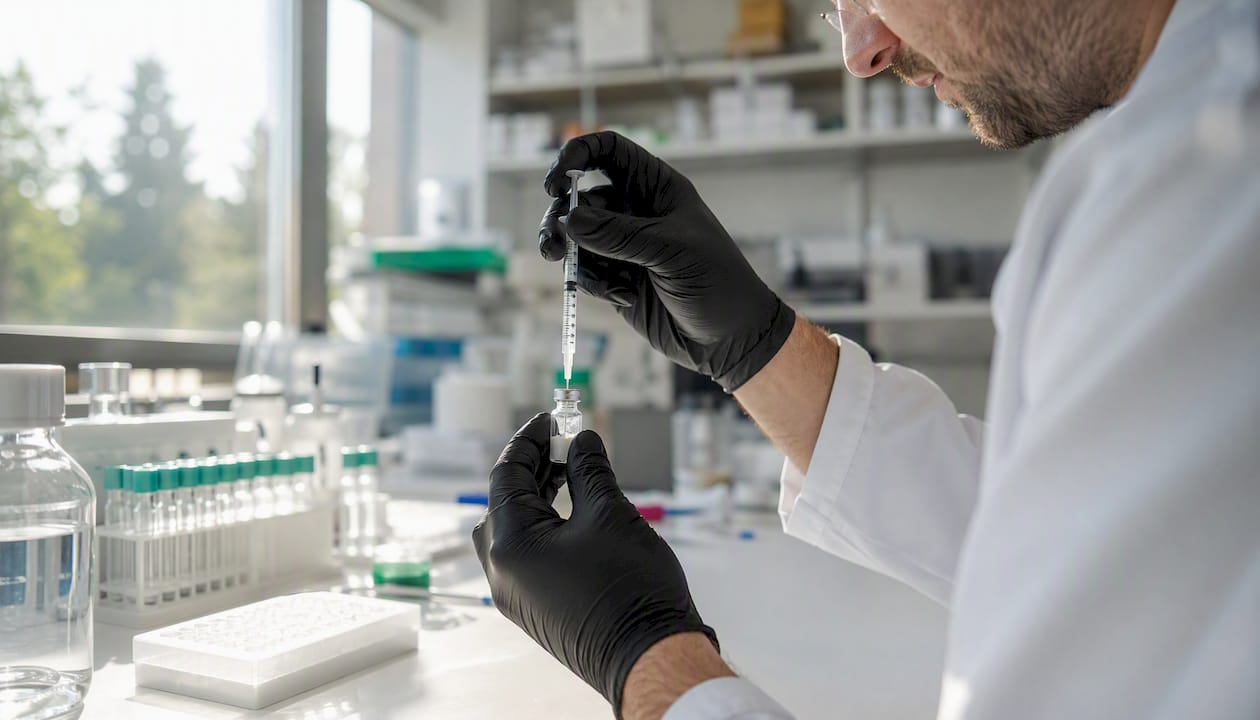
Scope: This guide covers preparation and documentation of peptide stock solutions for analytical, in-vitro and other authorised laboratory workflows. It does not provide information for administration to humans or animals.
Research Use Only. Not a medicine, food supplement or cosmetic. Not for human or veterinary use. No therapeutic or diagnostic use is intended.
Before preparation
- Confirm the material identity, batch or lot number, nominal mass and available analytical documentation.
- Review the sequence-specific literature and the intended assay method before selecting a solvent. Solubility and stability vary between materials; bacteriostatic water is not a universal laboratory solvent.
- Define the required final stock concentration, total final volume and aliquot plan in the study record.
- Confirm that balances, calibrated micropipettes and volumetric equipment are within their validated ranges.
Aseptic laboratory handling
Use a clean, controlled workspace appropriate to the assay. Disinfect external vial surfaces where required by the laboratory procedure. Use sterile or certified low-binding consumables when the workflow requires them, and avoid touching closures or transfer surfaces.
Aseptic handling reduces introduced contamination but does not make an unverified material sterile or suitable for use in a living organism.
Solvent compatibility
Select the solvent from validated method information, sequence-specific solubility data or a documented laboratory procedure. Consider pH, ionic strength, oxidation sensitivity, adsorption and compatibility with downstream chromatography, spectroscopy or cell-based assays.
Where an organic co-solvent or buffer exchange is required, follow an established method appropriate to that compound and analytical platform. Record the solvent grade, composition, lot and final concentration.
Preparing a stock solution
- Verify and record the reference-material mass from the label and relevant Certificate of Analysis.
- Calculate the final solvent volume required for the intended stock concentration: volume = mass ÷ concentration.
- Transfer solvent using calibrated volumetric equipment. Direct the liquid gently against the inside vial wall when this is specified by the material-handling procedure.
- Allow the material to dissolve using the least disruptive validated mixing method. Avoid vigorous agitation unless the method specifically requires it.
- Inspect for undissolved material, precipitation or unexpected colour change and document any deviation before using the stock in an assay.
Example: 5 mg reference material made to a final volume of 5 mL produces a 1 mg/mL stock solution.
Analytical aliquots and intermediate dilutions
Calculate aliquot volume from the verified stock concentration: aliquot volume = required analytical quantity ÷ stock concentration. Use a calibrated micropipette appropriate to the calculated range. If a volume falls below the validated range, prepare and document an intermediate dilution rather than estimating the transfer.
For multi-component materials, calculate from the verified component ratio or batch documentation. Do not assume that total nominal vial mass represents each component equally.
Labelling and documentation
Record material identity, batch number, verified mass, solvent and grade, final volume, calculated concentration, preparation date, preparer, storage condition and any intermediate-dilution factor. Retain the applicable COA and method reference with the study record.
Storage and freeze/thaw management
Storage requirements are material- and formulation-specific. Follow batch documentation and relevant stability literature rather than applying one universal duration. Protect light-sensitive materials where justified. When repeated freeze/thaw exposure could affect stability, prepare labelled single-use aliquots and document each storage excursion.
Do not state a post-preparation shelf life unless it is supported for the specific material, solvent, concentration and storage condition.
Quality checks before analytical use
- Confirm the batch on the vial matches the analytical documentation.
- Check that identity and purity results apply to the material being used.
- Review whether the intended workflow also requires endotoxin, sterility, residual-solvent or other testing; HPLC purity and mass-spectrometric identity do not establish those properties.
- Document deviations, precipitation, contamination concerns or calculation corrections before proceeding.
Calculation support
Use the Laboratory Stock Concentration Calculator for stock-concentration and analytical-aliquot calculations.
Further reading
- Published methodology for peptide/peptidomimetic preparation for circular-dichroism analyses
- How to Read a Certificate of Analysis
- The Science of Peptide Lyophilization and Stability
This educational material concerns laboratory preparation only. It is not a substitute for a validated laboratory method, institutional approval or compound-specific safety assessment.
