
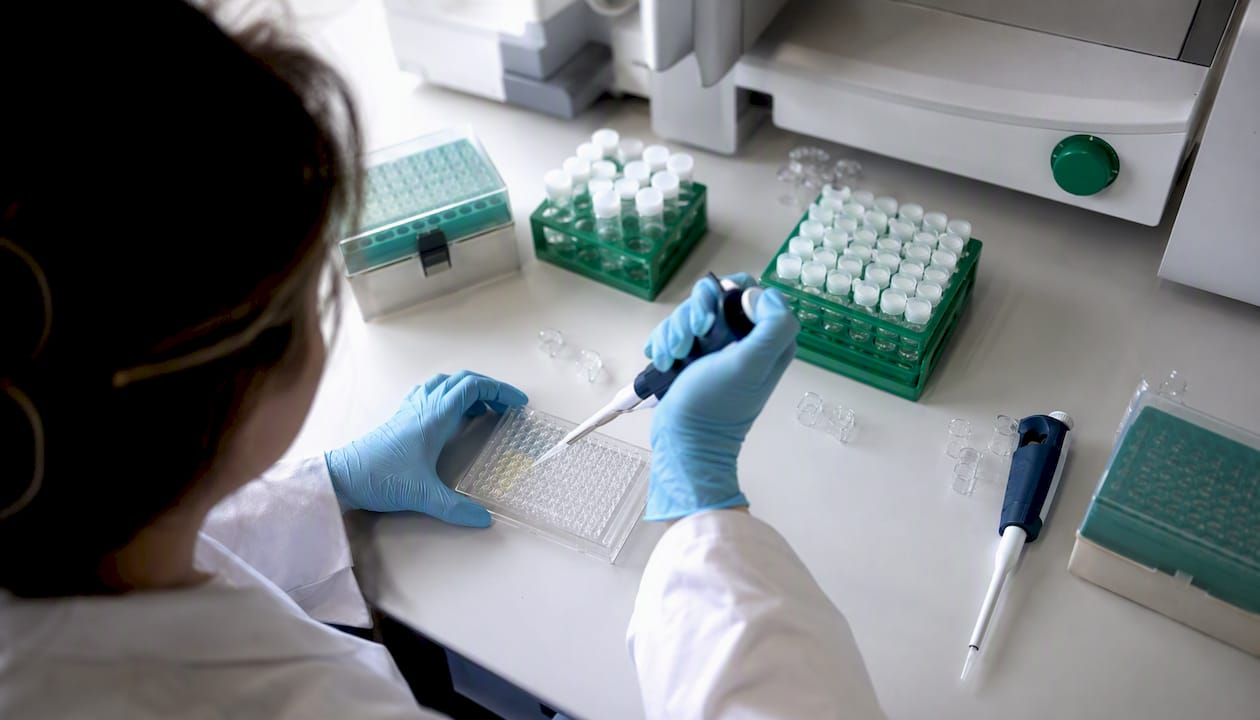
For peptide samples destined for biological assays or in vivo work, the recommended primary methods are quantitative kinetic chromogenic or kinetic turbidimetric LAL assays, with gel-clot serving as the pharmacopoeial referee when disputes arise. Recombinant Factor C (rFC) is an increasingly accepted alternative where animal-derived reagent concerns apply. Results should be expressed in Endotoxin Units per milligram (EU/mg) or per millilitre (EU/mL), and the applicable limit calculated using the USP <85> formula: L = K ÷ M, where K is the threshold constant (EU/kg for most parenteral routes; lower for intrathecal) and M is the maximum dose in mg/kg per hour.
Table of Contents
- Why do endotoxins matter specifically in peptide research?
- Which endotoxin detection methods are suitable for peptide samples?
- How do peptide-specific matrix effects interfere with LAL and rFC assays?
- How do you interpret EU/mg results for research-use-only peptides?
- How do you choose a UK laboratory for peptide endotoxin testing?
- How should peptide samples be prepared and shipped for endotoxin testing?
- Key takeaways
- Why independent endotoxin testing should be standard practice, not an afterthought
- Research-grade peptides with independent endotoxin-relevant QC from Veridianlabs
- Useful sources and further reading
Why do endotoxins matter specifically in peptide research?
Endotoxins are lipopolysaccharides (LPS) shed from the outer membrane of Gram-negative bacteria. Even at sub-nanogram concentrations, LPS activates Toll-like receptor 4 (TLR4), triggering cytokine cascades that can confound virtually any cell-based or in vivo experiment. For peptide researchers, this creates a specific problem: a peptide batch can achieve ≥98% chemical purity by high-performance liquid chromatography yet still carry endotoxin levels sufficient to produce measurable immune activation in macrophage or dendritic cell cultures.
The practical consequences are well documented. Endotoxin contamination can produce false-positive NF-κB reporter signals, inflate IL-6 and TNF-α readouts, and suppress or enhance proliferation assays in ways that are indistinguishable from the peptide’s own biological effect. Reproducibility suffers accordingly: two batches of the same peptide at identical HPLC purity may produce divergent biological results if their endotoxin burdens differ. Regulatory guidance documents, including those aligned with ICH Q6B principles, specify that purity testing and biological safety testing address distinct quality attributes and must both be conducted.
For peptide APIs intended for injectable formulations, guidance from Polypeptide Group explicitly recommends including bioburden and endotoxin testing within the product specification, regardless of whether the finished dosage form undergoes terminal sterilisation. The rationale is straightforward: sterilisation removes viable organisms but does not degrade LPS, so endotoxin testing must be performed on the API or the final formulation.
Key sources of endotoxin contamination in peptide manufacturing include:
- Solid-phase synthesis resins and coupling reagents that have been exposed to non-sterile water.
- Lyophilisation equipment and stoppers that have not been depyrogenated.
- Reconstitution buffers prepared without endotoxin-free water.
- Low-bind tubes and pipette tips that are not certified endotoxin-free.
Which endotoxin detection methods are suitable for peptide samples?
Three method families are accepted under current pharmacopoeial frameworks, each with distinct sensitivity profiles, throughput characteristics, and compatibility considerations for peptide matrices.
| Method | Principle | Quantitative? | Typical sensitivity | Key advantage | Key limitation |
|---|---|---|---|---|---|
| Gel-clot LAL | Clot formation in the presence of LPS | Qualitative (pass/fail) | — | Pharmacopoeial referee; low equipment cost | No numeric result; low throughput |
| Kinetic turbidimetric LAL | Turbidity increase over time | Quantitative | — | Widely validated; good throughput | Susceptible to coloured or turbid samples |
| Kinetic chromogenic LAL | Colour change via chromogenic substrate | Quantitative | — | Highest sensitivity; dominant in pharma QC | Coloured peptide solutions may interfere |
| Recombinant Factor C (rFC) | Fluorescent readout via recombinant enzyme | Quantitative | — | No animal-derived reagents; reproducible | Not yet universally accepted in all pharmacopoeias |
| Monocyte Activation Test (MAT) | Cytokine release from human monocytes | Quantitative | Detects all pyrogens | Detects non-LPS pyrogens | Complex; not routine for research-grade QC |
LAL-based methods derive from horseshoe crab (Limulus polyphemus) haemolymph and measure the activation of a serine protease cascade rather than LPS directly. The terminal readout distinguishes the three LAL variants: gel-clot produces a physical clot, turbidimetric methods track optical density, and chromogenic methods measure the release of p-nitroaniline from a synthetic substrate. Kinetic chromogenic assays are the commercial standard for quantitative COA reporting because of their sensitivity and compatibility with automated plate readers.
The rFC assay replaces the animal-derived lysate with a recombinant enzyme that retains LPS specificity. USP <86> now provides a framework for rFC use, and its adoption is growing in UK pharmaceutical laboratories seeking to reduce reliance on horseshoe crab harvesting. The Monocyte Activation Test detects the full spectrum of pyrogenic contaminants, including non-endotoxin pyrogens, but its complexity and cost make it unsuitable as a routine first-line assay for research peptides.
It is worth noting that LC-HRMS methods, which can confirm peptide sequence and quantify impurities at LODs of approximately 0.02–0.04 μM, provide no information on endotoxin burden. Similarly, UHPLC-UV-HRMS workflows that enable relative quantification across complex peptide pools address chemical identity and purity, not biological contamination. A complete quality picture requires both orthogonal chemical methods and a dedicated endotoxin assay; neither substitutes for the other. Researchers can review how HPLC and mass spectrometry verify purity and identity separately from endotoxin testing.
How do peptide-specific matrix effects interfere with LAL and rFC assays?
Peptide samples present a range of matrix challenges that are not encountered with simple aqueous solutions. Understanding each interferent and its mechanism allows researchers to design sample preparation that preserves assay validity.
Sample preparation options
- Buffer exchange: — Use centrifugal ultrafiltration (e.g., Amicon Ultra, 3 kDa MWCO) with endotoxin-free water to remove TFA, solvents, and small-molecule interferents while retaining the peptide. Verify that the peptide does not adsorb to the membrane.
Peptide stability during sample preparation is a parallel concern: aggressive buffer exchange or prolonged incubation at room temperature can degrade labile sequences, so preparation should be conducted on ice where possible.
Pro Tip: Run spike/recovery controls at three dilution levels (1×, 2×, and 4× MVD) during method development. If recovery is acceptable only at the highest dilution, that dilution becomes your validated working concentration, and you report results corrected for the dilution factor.
How do you interpret EU/mg results for research-use-only peptides?
A numeric EU/mg result is only meaningful when compared against a calculated limit that reflects the intended route and dose. The USP <85> formula (L = K ÷ M) provides that limit, and the calculation should be performed before the assay is run so that the acceptance criterion is pre-defined rather than post-hoc.

For common research doses in an adult equivalent, calculated endotoxin limits become progressively more stringent as dose increases. At very low doses, the allowable endotoxin per milligram can be relatively high, though cell-based assays remain sensitive to endotoxin at much lower concentrations. For in vitro cell culture, the pharmacopoeial formula does not apply directly, but published literature suggests that endotoxin concentrations as low as 0.1–1 EU/mL can produce measurable cytokine responses in sensitive cell lines. Research-use-only peptides should therefore target the lowest achievable endotoxin burden, not merely compliance with a calculated parenteral limit.
Commercial testing services describe endotoxin removal procedures alongside testing, with some marketing post-removal concentrations in the low EU/μg range. Researchers should treat such marketing claims with appropriate caution and request method-suitability data and COA documentation before relying on a supplier’s stated endotoxin level.
Threshold context: For in vivo rodent studies, many institutional animal ethics committees and published protocols apply a limit of ≤1 EU per dose as a practical working threshold, though this is not a universal regulatory requirement for research-use-only material. Always confirm the applicable limit with the study protocol and, where relevant, the ethics committee.
How do you choose a UK laboratory for peptide endotoxin testing?
Selecting an appropriate testing laboratory requires more than confirming that the lab offers a LAL assay. The COA produced must contain sufficient methodological detail for the result to be scientifically defensible, and the lab’s quality system must be auditable. UK testing services such as PeptideVerify advertise LAL-based endotoxin testing specifically for peptides and provide COA examples with endotoxin lines, which gives a useful benchmark for what a well-documented report should contain.
Questions to ask before submitting samples
- What assay format is used: kinetic chromogenic, kinetic turbidimetric, or rFC?
- What is the assay LOD and LOQ, and what is the standard curve range?
- Is method suitability (spike/recovery) performed on each sample type, or only on a generic matrix?
- Does the laboratory hold UKAS accreditation or ISO 17025 certification, and does the scope cover endotoxin testing?
- What sample volume and concentration are required, and in what container format?
- What is the standard turnaround time, and is expedited reporting available?
What a valid COA should contain
A COA for endotoxin testing should specify: assay type and reagent lot number; standard curve parameters and r² value; sample dilution factor and MVD; spike/recovery percentage; result in EU/mg or EU/mL with the LOD stated; and a clear pass/fail statement against the pre-defined limit. Reviewing how to read a Certificate of Analysis before engaging a laboratory helps researchers identify whether a report meets these standards.
In-house versus outsourced testing
| Consideration | In-house assay | Accredited external lab |
|---|---|---|
| Upfront cost | High (reader, reagents, validation) | Low (per-sample fee) |
| Per-sample cost | Lower at volume | Higher per sample |
| Turnaround | Same-day possible | Typically 2–5 working days |
| Regulatory standing | Requires internal validation and QMS | ISO 17025/UKAS provides independent assurance |
| Suitable for | High-throughput programmes with dedicated QC resource | Occasional testing or regulatory submissions |
For most academic and early-stage research groups in the UK, outsourcing to an accredited laboratory is the more practical route. Developing an in-house kinetic chromogenic assay requires capital investment in a plate reader with kinetic capability, validated reagent stocks, and a documented quality management system. A framework for evaluating UK peptide suppliers and their testing claims provides additional criteria for assessing whether a supplier’s stated endotoxin data is credible.
How should peptide samples be prepared and shipped for endotoxin testing?
Sample integrity at the point of testing is as important as the assay itself. Contamination introduced during preparation or shipping can produce false-positive results that are indistinguishable from genuine product contamination.
Step-by-step sample preparation
- Prepare all surfaces and equipment in a laminar flow cabinet or biosafety cabinet where possible; wipe down with 70% IPA and allow to dry before use.
- Use only certified endotoxin-free, low-bind polypropylene tubes (e.g., Eppendorf LoBind or equivalent) and endotoxin-free pipette tips throughout.
- Reconstitute lyophilised peptide in endotoxin-free water (LAL reagent water) or endotoxin-free PBS, not standard laboratory water.
- If the peptide is supplied in an organic solvent or contains TFA, perform buffer exchange using endotoxin-free ultrafiltration devices before aliquoting for testing.
- Aliquot into single-use volumes sufficient for the assay plus a confirmatory replicate; avoid freeze-thaw cycles after aliquoting.
- Label each vial with: peptide identifier, batch number, concentration (mg/mL), diluent, date of preparation, and storage condition.
Shipping checklist
- Ship lyophilised material where possible; reconstituted peptides are more susceptible to degradation and contamination during transit.
- Use validated cold-chain packaging: dry ice for frozen material, or 2–8°C gel packs for refrigerated shipment, with a temperature indicator included in the outer box.
- Include a completed sample submission form specifying: peptide name, batch number, concentration, diluent, requested assay type, and the endotoxin limit to be tested against.
- Provide a minimum of two aliquots per sample: one for the primary assay and one for confirmatory testing or repeat analysis if spike/recovery fails.
- Confirm the laboratory’s acceptance criteria for sample volume (typically 0.5–2 mL per aliquot for kinetic assays) before dispatch.
For lyophilised peptides, stability during storage and shipping depends on maintaining low moisture and appropriate temperature; samples that have been exposed to humidity or temperature excursions should be flagged to the laboratory before testing.
Key takeaways
Reliable peptide endotoxin testing requires a quantitative assay with validated method suitability controls, a pre-defined limit calculated from the intended dose and route, and a COA that documents spike/recovery data, reagent lot, and assay sensitivity.
| Point | Details |
|---|---|
| Choose a quantitative assay | Kinetic chromogenic or rFC assays provide numeric EU/mg results; gel-clot is the referee method only. |
| Run method suitability controls | Spike/recovery must fall within 50–200% at the intended dilution; document MVD and LOD before reporting. |
| Calculate the limit before testing | Apply L = K ÷ M using the intended dose and route; for in vitro work, target the lowest achievable burden. |
| Address matrix interference | Buffer exchange, dilution to MVD, and low-bind plastics are the primary mitigation strategies for peptide samples. |
| Veridianlabs COA transparency | Veridianlabs supplies research-grade peptides with independent COA documentation, supporting researchers who require traceable endotoxin data alongside HPLC purity verification. |
Why independent endotoxin testing should be standard practice, not an afterthought
The assumption that chemical purity is a proxy for biological safety is one of the most persistent and consequential errors in peptide research. A batch at 99% HPLC purity can carry endotoxin at concentrations that will activate innate immune pathways in any cell line expressing TLR4, which includes most primary immune cells and many tumour lines. The result is not a subtle background effect; it can be a statistically significant, publication-grade artefact.
What is frequently underestimated is how late in a project this problem tends to surface. Endotoxin contamination is rarely identified during synthesis or initial characterisation, because HPLC and mass spectrometry, however sophisticated, are blind to LPS. It emerges when a biological result fails to replicate, when a collaborating laboratory using a different peptide batch obtains divergent data, or when a reviewer requests endotoxin data that was never collected. At that point, the cost in time and resource is substantially higher than it would have been had endotoxin testing been built into the QC specification from the outset.
The practical argument for independent testing, rather than relying on a supplier’s stated values, is equally straightforward. Endotoxin levels can change between synthesis batches, during storage, and during reconstitution. A COA endotoxin line from the original batch does not guarantee the endotoxin burden of the material as received, particularly if the material was exposed to contamination, moisture, or physical damage in transit. Veridianlabs addresses this by providing independent COA documentation per batch, secure bubble-wrap packaging, and transparent quality records, so researchers have a traceable baseline from which to work.

The field is moving towards treating endotoxin testing as a routine line item in peptide QC, not a specialist add-on. That shift is overdue.
Research-grade peptides with independent endotoxin-relevant QC from Veridianlabs

Veridianlabs supplies research-grade peptides verified to ≥98% HPLC purity, each accompanied by an independent Certificate of Analysis that documents purity, identity, and batch-specific quality data. Every order is fulfilled with secure bubble-wrap packaging, standard tracked courier dispatch, and research-use-only labelling, in compliance with UK regulatory requirements. For researchers who require traceable quality documentation as the starting point for their own endotoxin testing workflow, Veridianlabs provides the transparent product records and batch consistency that make downstream assay validation more straightforward.
All VeridianLabs products are sold strictly for laboratory research use only (RUO) and are not intended for human or veterinary use. Researchers should confirm applicable endotoxin limits with their institutional ethics committee or regulatory affairs team before use.
View the full range of research-grade peptides and associated quality documentation, or consult the COA guide to understand what a well-documented batch record should contain before selecting a supplier.
Useful sources and further reading
The following primary references and guidance documents support the methods and validation approaches described in this article. Researchers are advised to retain copies of applicable guidance alongside their method-suitability data and run logs for audit purposes.
- Regulatory Guidelines for the Analysis of Therapeutic Peptides and Proteins – PMC
- Liquid Chromatography-High Resolution Mass Spectrometry for Peptide Drug Quality Control – PMC
- Quality control of synthetic peptide pools using UHPLC-UV-HRMS – MDPI
- Limulus amebocyte lysate – Wikipedia
- LPS & Endotoxin Testing UK | LAL Testing for Peptides
- Biological Testing Services for Peptide Characterization (Creative Peptides)
- Other tests and specifications for peptide APIs (Polypeptide PDF)
- Control strategies for synthetic therapeutic peptides (Polypeptide PDF)
This article provides general scientific and methodological information for qualified researchers. It does not constitute regulatory or professional advice. Researchers should confirm applicable endotoxin limits, testing requirements, and regulatory obligations with their institutional quality team or a qualified regulatory affairs professional.
